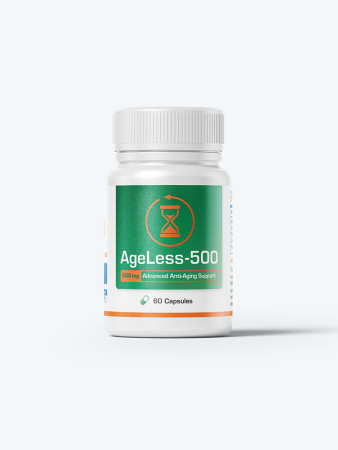
AgeLess-500
Advanced Anti-aging Support
Key Functions:
- Helps increase NAD+ levels to support cellular energy production and healthy aging
- Activates sirtuins (like SIRT1) to help support DNA repair and cellular health
- Provides TMG to support healthy methylation and assist the conversion of NMN to NAD+
- Supports the body’s natural process of clearing senescent (“aging”) cells
- Offers antioxidant and anti-inflammatory support
- Improves supplement absorption and bioavailability with black pepper extract (piperine)
- Supports healthy methylation and homocysteine balance
Ingredient Summary

How the Formula Works: A Synergistic Approach to Longevity
The five ingredients in AgeLess-500 are functionally interdependent. Each addresses a specific vulnerability in the cellular aging process, and several pairs interact directly to amplify one another’s effects.
NMN — Rebuilding the NAD+ Foundation
NMN is a direct biosynthetic precursor to NAD+, the coenzyme central to cellular energy metabolism, DNA repair, and longevity signaling. [3] NAD+ levels are understood to decline with age, which can reduce mitochondrial efficiency, impair DNA repair, and diminish sirtuin activity. [4] In a randomized, placebo-controlled trial, healthy older men who took 250 mg of NMN daily for 12 weeks showed significantly higher whole-blood NAD+ levels compared to placebo, along with improvements in gait speed and grip strength. [1] A comprehensive 2023 review of human NMN trials similarly reports NAD+ elevation as the most consistent finding across studies, with safety data generally favorable at studied doses. [2]
Trans-Resveratrol — Activating the Longevity Signaling Network
Resveratrol is a natural plant compound found in foods like grape skins. It’s of interest in longevity research because it can activate sirtuins, a group of enzymes linked to lifespan extension in multiple organisms [4]. Resveratrol activates SIRT1, which helps regulate genes involved in inflammation, mitochondrial function, and cellular stress resistance. Importantly, this process depends on adequate levels of NAD+, which is part of the rationale of addingresveratrol to this product.
TMG (Trimethylglycine) — Protecting Methylation Balance
Converting NAD+ precursors like NMN into usable form consumes methyl groups via enzymes such as NNMT, which uses the body’s universal methyl donor (SAM) to process nicotinamide — a reaction that also generates homocysteine as a byproduct. [5] High-level NAD+-precursor intake without methyl donor support could, over time, draw down methylation capacity and contribute to elevated homocysteine. TMG is one of the body’s primary methyl donors, and human studies show it lowers circulating homocysteine at supplemental doses. [6] It’s included here so methyl group availability scales alongside NMN intake across the dosing range.
Quercetin — Preserving NAD+ and Supporting Senescent Cell Clearance
Quercetin is a flavonoid which plays two distinct and complementary roles in this formula. First, it is a well-studied inhibitor of CD38, an enzyme that degrades NAD+ and whose activity increases substantially with age. Research has demonstrated that age-related NAD+ decline is driven in significant part by increased CD38 activity rather than decreased biosynthesis alone, making CD38 inhibition a meaningful strategy for preserving NAD+ availability [7].
Second, quercetin has senolytic properties, allowing it to selectively promote the clearance of senescent cells that accumulate with age and contribute to chronic low-grade inflammation. This dual role makes quercetin a functionally rich addition to a longevity-focused formula.
Piperine — Supporting Polyphenol Bioavailability
Resveratrol and quercetin are both well-studied but share a common limitation: they’re broken down quickly by the intestines and liver, limiting how much reaches the bloodstream. Piperine, the active compound in black pepper, has been shown in animal research to slow the glucuronidation process that clears resveratrol, meaningfully increasing how much stays in circulation. [8] A broader review of bioavailability strategies for resveratrol and related stilbenes identifies piperine as one of the more consistently effective co-administered bioenhancers studied to date. [9] A 95% piperine extract is used here as a standardized, concentrated dose.
References
- Igarashi M, Nakagawa-Nagahama Y, Miura M, et al. Chronic nicotinamide mononucleotide supplementation elevates blood nicotinamide adenine dinucleotide levels and alters muscle function in healthy older men. npj Aging. 2022;8(1):5.
- [Adv Nutr review author team]. The Safety and Antiaging Effects of Nicotinamide Mononucleotide in Human Clinical Trials: an Update. Adv Nutr. 2023;14(6):1416–1435.
- Yu B, Jing X, Jia L, et al. The versatile multi-functional substance NMN: its unique characteristics, metabolic properties, pharmacodynamic effects, clinical trials, and diverse applications. Front Pharmacol. 2024;15:1436597.
- Verdin E. NAD+ in aging, metabolism, and neurodegeneration. Science. 2015;350(6265):1208–1213.
- [NNMT review authors]. Nicotinamide N-Methyltransferase (NNMT): A New Hope for Treating Aging and Age-Related Conditions. Metabolites. 2024;14(6):343.
- Steenge GR, Verhoef P, Katan MB. Betaine supplementation lowers plasma homocysteine in healthy men and women. J Nutr. 2003;133(5):1291–1295.
- Escande C, Nin V, Price NL, et al. Flavonoid apigenin is an inhibitor of the NAD+ase CD38: implications for cellular NAD+ metabolism, protein acetylation, and treatment of metabolic syndrome. Diabetes. 2013;62(4):1084–1093.
- Johnson JJ, Nihal M, Siddiqui IA, Bailey HH, Mukhtar H, Ahmad N. Enhancing the bioavailability of resveratrol by combining it with piperine. Mol Nutr Food Res. 2011;55(8):1169–1176.
- [Review authors]. Enhancing Bioavailability of Nutraceutically Used Resveratrol and Other Stilbenoids. Nutrients. 2021;13(9):3095.