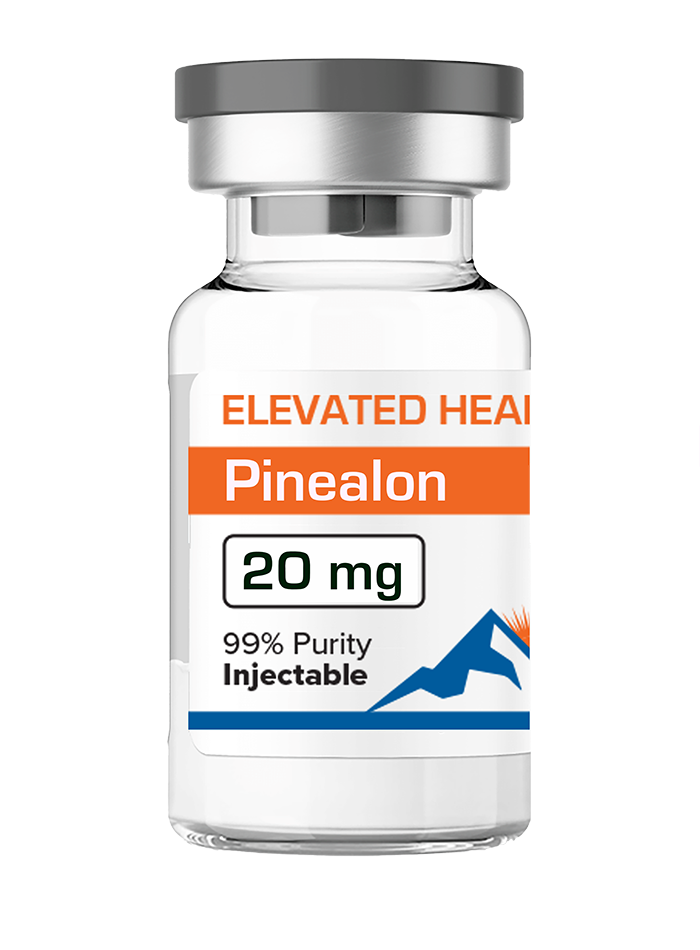
Pinealon-20mg – Anti-aging Peptide
Product Overview
Pinealon is associated primarily with research on the central nervous system, neuroprotection, and cognitive function. Research conducted in Russia suggests that Pinealon possesses anti-aging properties, particularly in the central nervous system. This peptides has been found to have anabolic effects in the brain, potentially slowing the aging process when assessed using biological age indicators.
Pinealon’s influence extends beyond the central nervous system, as it also affects muscle cells by modulating the expression of irisin. Irisin plays a crucial role in safeguarding muscle cells during exercise, promoting fat burning, and is believed to induce telomere elongation. By increasing the lifespan of irisin, Pinealon enhances telomere protection, combating the effects of aging and oxidative stress. Notably, plasma irisin levels are directly linked to telomere length in healthy adults. Furthermore, irisin levels have been associated with calorie restriction, a well-established method to prolong life and improve overall fitness. These observations suggest that irisin, which Pinealon affects, may have systemic anti-aging effects throughout the body, including the brain.
Unlike most peptides, pinealon does not appear to bind to cell surface or cytoplasmic receptors. This has led scientists to wonder how the short peptide can have any effect. In the past, it was suggested that pinealon may be small enough to cross lipid bilayers (e.g. the cell membrane, nuclear membrane) and may therefore be able to interact directly with DNA. Testing in cell cultures (HeLa cells) indicates that pinealon directly penetrates the cell membrane as well as the nuclear membrane to interact with DNA. This makes pinealon a regulator of gene expression and explains the peptide’s myriad effects that cannot be explained by receptor interactions.
Key Benefits:
- Supports irisin signaling (a protein discussed in exercise adaptation and metabolism), with downstream discussion around cellular resilience.
- Helps reduce hypoxia-related cellular damage in the brain by supporting the body’s antioxidant defenses.
- Influences mood-related signaling via increased 5-tryptophan hydroxylase activity, which is involved in serotonin production.
- In the context of the pineal gland, it’s also described as supporting circadian rhythm alignment and sleep.
How Does It Work?
Pinealon (Glu-Asp-Arg / EDR) is an ultrashort tripeptide proposed to act primarily through direct interaction with cellular and nuclear targets rather than classical cell-surface receptor signaling. The main researched mechanisms include:
1. Direct DNA / Chromatin Interaction & Gene Expression Modulation:
According to the Khavinson bioregulator model, short peptides such as EDR can penetrate cell membranes and enter the nucleus, where they interact with specific DNA sequences or histone proteins. This is thought to modulate the transcription of genes involved in neuronal survival, antioxidant defense, synaptic plasticity, and apoptosis regulation. Biophysical studies have reported physical interaction of EDR with DNA (including major groove binding).
2. Neuroprotection Against Oxidative Stress & Cell Death
In neuronal cell culture models (including cerebellar granule cells, PC12 cells, and others), Pinealon has been shown to:
- – Reduce accumulation of reactive oxygen species (ROS)
- – Lower markers of necrotic and apoptotic cell death (including caspase-3 and p53-related pathways)
- – Improve cell viability under oxidative or excitotoxic challenge
These effects appear dose-dependent in the published in vitro work.
3. Support of Neuronal Structure & Plasticity
Research has reported preservation or restoration of dendritic spine density in models of amyloid toxicity and other neurodegenerative conditions. Modulation of genes linked to synaptic plasticity (e.g., GAP-43) and neural progenitor markers has also been described.
4. Antioxidant Enzyme & Signaling Pathway Effects
Studies from the originating research group indicate upregulation of antioxidant enzymes (such as SOD2 and GPX1) and influence on signaling pathways including MAPK/ERK, as well as transcription factors such as PPARA and PPARG. Effects on serotonin-related pathways have also been noted in some reports.
5. Pineal / Circadian Rhythm
Although Pinealon is more strongly associated with cortical/neuronal tissue than Epithalon, it originates from the same pineal-related research tradition and has been examined in contexts involving circadian disruption and age-related neuroendocrine changes.
Summary of Current Understanding
Pinealon’s primary researched actions center on neuroprotection (particularly under oxidative stress), support of neuronal survival and structure, and epigenetic-style modulation of gene expression relevant to brain aging and injury models. Most mechanistic and preclinical data originate from a single research group, with limited independent replication to date. Human clinical observations exist but are generally small, open-label, or combination studies.
Neuroprotection
- Reduction of oxidative damage, ROS, and cell death in neuronal cultures; protective effects in models of hypoxia, hyperhomocysteinemia, and excitotoxicity.
Cognitive function & memory
Improvements in spatial memory and learning performance reported in aged or stressed rodent models; limited human observations in post-traumatic or age-related cognitive contexts.
Synaptic and structural support
Preservation of dendritic spines in models relevant to Alzheimer’s and Huntington’s disease research.
Antioxidant and anti-apoptotic activity
Upregulation of protective enzymes and downregulation of pro-death markers.
Potential applications in brain injury and aging models
Exploratory work related to traumatic brain injury sequelae, cerebral asthenia, and age-related cognitive decline.
Dosage Regime:
Suggested Research Protocols (Literature-Based)
These are drawn from published Russian clinical/research protocols and common laboratory usage patterns.
Typical Range: 5–10 mg per day (subcutaneous) for 10–20 consecutive days is commonly referenced in research community protocols.
Cycling: Short courses (10–20 days) repeated 1–3 times per year, consistent with the broader bioregulator approach.
Administration Route: Subcutaneous injection is the most common route, sublingual and intranasal routes are also discussed.
Timing: Often morning or daytime in cognitive-focused protocols.
References
1. Khavinson V, Linkova N, Kozhevnikova E, Trofimova S. EDR Peptide: Possible Mechanism of Gene Expression and Protein Synthesis Regulation Involved in the Pathogenesis of Alzheimer’s Disease. *Molecules*. 2020;26(1):159. PMID: [33396470](https://pubmed.ncbi.nlm.nih.gov/33396470/)
2. Khavinson V, Ribakova Y, Kulebiakin K, et al. Pinealon increases cell viability by suppression of free radical levels and activating proliferative processes. *Rejuvenation Res*. 2011.
3. Additional supporting work appears in *Bulletin of Experimental Biology and Medicine*, *Archives of Gerontology and Geriatrics*, and related publications from the St. Petersburg Institute of Bioregulation and Gerontology examining EDR peptide effects on neuronal cultures, oxidative stress, and cognitive models.
4. Human observational data (e.g., post-traumatic cognitive contexts) are limited and generally open-label; see reviews summarizing Russian clinical experience with Pinealon/Cortexin-related peptides.